Understanding Your Sleep Cycles
You have probably noticed that your sleep does not feel the same throughout the night and often differs from one night to the next. At some points on a typical night, you are aware of what’s happening around you, and at others, you are lost in dreamland. Some other parts of the night remain a distant memory, where you cannot tell whether you were dreaming or still listening to the noises around you. Well, this variation in awareness is not by coincidence, and it instead ties to the various stages of sleep that you go through. Put together, these stages make up a sleep cycle.
Now, your sleep is not made up of just one sleep cycle. Instead, every time you hit the sack, you go through a number of sleep cycles, all of which last about 90 minutes at a time. Assuming that you sleep the recommended 7 to 9 hours per night (or day for nightshift workers), then you repeat these sleep cycles anything from 4 to 6 times every night.
And in each complete sleep cycle, you go through the following phases: stage 1, stage 2, stage 3, and REM (rapid eye movement) sleep. It helps to note that stages 1, 2, and 3 are also referred to as non-REM sleep, i.e., non-rapid-eye-movement sleep, because they are not considered an active form of sleep like REM. Below are what each of these stages entails and why going through each of them is essential for your well-being.
Stage 1
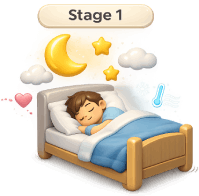
This stage is also known as the light sleep stage, and it serves as the gateway to deeper sleep. In most cases, it lasts a few minutes, during which you start feeling yourself growing more tired and sinking into sleep. Your heart rate slows down, your body temperature decreases, and you feel your muscles relax. For some people, muscle twitching occurs, and many others have experienced that ‘falling’ feeling where they find themselves jerking their feet to steady themselves. These are all signs that the body is getting ready for the second stage of sleep.
But changes don’t just take place externally. They also take place inside your brain. You find that you start feeling less alert, even if you are still somewhat aware of your surroundings, such that you can wake up if you hear noises or movements.
Not much takes place in terms of repair or memory processing during stage 1.
Stage 2
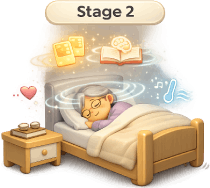
Once your body has relaxed, you move on to this stage of sleep, which accounts for about 50% of your sleep. Here, your muscles fully relax, your breathing becomes calm and regular, and your body temperature dips even more. All these changes are your body’s way of conserving energy so it can focus on the deeper repair that takes place later, as we will cover in the next section. At the same time, your brain starts going through your short-term memories and deciding what to keep and what to forget. So, any new facts or skills that you learned during the day become consolidated, which is a key part of learning.
But how does your body ensure that you do not wake up if you hear any noises or movements? Well, your brain produces activities known as sleep spindles and K-complexes, which act like natural headphones to shield you from external noises. Unless a noise is very loud, you sleep through it, and your brain gets to focus on helping you remember that new word you learned today.
Stage 3
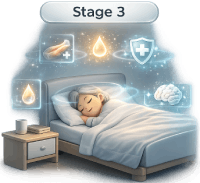
While stage 2 is quite long and stable, it is relatively light sleep, and as such, it is not the most restorative of the sleep stages. The most restoration comes from the 3rd stage of sleep, where the body goes into full repair mode. A lot happens in this stage. To start with, muscles and tissues undergo repair. Secondly, the body releases growth hormone, which is essential in rebuilding cells while strengthening bones and muscles. And thirdly, your immune system gets the boost it needs to help you fight off illnesses. These are but a few of the important functions that take place here.
Inside your brain, more consolidation of newly learned skills and knowledge takes place as the brain clears out waste products. With all these activities taking place, you literally get a clean slate as you rest. And that is why if you miss this stage of sleep, you will feel the effects of it the next day. Not only will you feel mentally exhausted, but you will also be physically wiped out.
Rapid Eye Movement (REM) Sleep
While people don’t like nightmares, they do enjoy dreams because they are like free movies or series with all sorts of endings. But does this part of your sleep fall into the sleep cycle? Why, yes!
REM sleep, also known as the dream stage, is the last part of the cycle. Usually, it starts 90 minutes after you have fallen asleep, and it takes place after stage 3. After it completes, you move back to stage 1 or stage 2, and the cycle continues. REM sleep is often longer towards the morning and shorter in the first hours of your sleep.
So, what exactly happens while you are dreaming? In REM sleep, your body is somewhat awake. Not only do your eyes move fast under your eyelids, but your heart rate also rises. In fact, your brain activity looks quite similar to the norm during wakefulness. And this is why you are able to have very vivid dreams that feel and look real. However, to keep you from acting out your dreams (and nightmares), your body paralyzes your muscles. Thus, as much as you experience your dreams, a gap exists between them and the real world.
You might wonder why dreams are necessary, beyond serving as entertainment during sleep cycles. Studies have shown that this type of sleep plays a role in helping people regulate their emotions, unleash their creativity, and consolidate their memories. Consolidation especially comes into play when you take things such as problem-solving and refining complex skills into account. If you miss out on this stage, you are likely to feel emotionally unstable, forgetful, and even experience brain fog the next day.
When Do These Stages Take Place?
As we said, stage 1 is often quite short and only takes a few minutes at a time. In fact, once you fall asleep, it is quite possible to go through the cycles over and again without going back to stage 1, such that they start at stage 2. So, when does each stage happen?
During the first half of the night, your body focuses on physical recovery. As such, you enjoy more stage 3 sleep here so that your body can repair your tissues and muscles, restore your energy, and boost your immunity.
During the second half of the night, you enjoy more REM sleep, where your brain focuses on helping you process your emotions, explore your creativity, and consolidate your memories.
Stage 2 takes place throughout the night and acts as the link between REM and stage 3 sleep. Not only does it support the physical recovery taking place, but it also supports your brain function, ensuring that you achieve a good balance of the two.
The Influence of the Circadian and Other Body Rhythms on Sleep
While many studies focus on the standard 24-hour cycle where people feel most alert in the morning and are sleepiest towards the early hours of the night, the truth is that we are all different. Our sleep cycles are heavily influenced by several internal processes in our bodies that determine when and how we sleep, alongside other activities. As such, while some people may feel alert in the morning, others may come alive in the afternoon or at night, and that is because our systems run at different paces. That is why it is important to focus on more than just the circadian rhythm when it comes to our sleep.
That said, let’s dive into the individual differences that rear their heads when it comes to our sleep preferences and routines.
The Circadian Rhythm
We cannot talk about sleep patterns without touching on the master clock that is at the heart of it all. Every person has a circadian rhythm, which is essentially their body’s internal clock that determines when their sleep cycles start and stop. Additionally, it tells them when it is time to be alert and when it is time to slow down.
Suppose you are a typical person. In this case, your rhythm depends on light and darkness. When the sun rises, this light signals to your brain that it is time to release cortisol, which is the hormone that wakes you up and gives you the energy to get going. And when the sun sets, and the darkness covers the sky, this triggers your body to release melatonin, which calms you and helps you sleep. Many people are like this, such that they feel sleepy towards 10 and 11 pm and feel alert from 6 to 8 am.
But not everybody follows this rhythm. Take night owls as an example. They tend to wake up much later than 8 am and are often quite alert even past midnight. And when it comes to the early birds, they wake up before dawn and tend to fall asleep much earlier than 10 or 11 pm.
So, what causes this difference in rhythms? It largely comes down to a person’s lifestyle, age, and genetics. For example, a night shift worker may find that they are more of a night owl as they have adapted to their work schedule.
It is important to note that regardless of your circadian rhythm, it is important to follow a sleep routine that matches it for your sleep cycles to flow smoothly. Whenever you fight your rhythm, your sleep cycles get cut short, and this results in lower quality sleep.
Other Rhythms in Our Bodies
While the circadian rhythm is considered to be the master clock in our bodies, there are many other internal processes that determine our sleep patterns. These are:
Hormonal Rhythms
Beyond cortisol and melatonin, our bodies also release growth and other hormones. All these hormones work together as the chemical messengers in our bodies to affect our energy and relaxation levels, as well as our overall recovery. In a typical person, these hormones follow set schedules based on the time of the day. But where these hormones get interrupted by factors such as stress or jet lag, then their release can take place at different times and can result in effects such as fatigue, which can affect your sleep routine.
Digestion
During the day, the digestive system is at its most active, and metabolism is at its peak. But as the night settles in, digestion slows down. For many people, eating heavy meals at night causes overall discomfort, which negatively affects their sleep. However, there are people who can tolerate large and heavy meals late at night.
Brain Function
If you look at a typical person, you will see that their brain function changes throughout the day. In the morning, they are at their sharpest and can handle complex problems with ease. Towards the afternoon, they get that afternoon slump where they need a walk or an extra cup of coffee to stay alert. And come the evening, they change their focus to creative tasks and socialization, as their emotional processing abilities increase. On the contrary, you will find some people who think better at night and others whose mental focus drops sharply once the sun goes down.
Like with the circadian rhythm, changes to these other rhythms have an effect on your sleep cycles. For instance, if you eat late at night and yet are prone to acid reflux, this will fragment your sleep cycles as you will have to keep waking up, and this will result in low-quality sleep. A key part of enjoying smooth sleep cycles thus lies in understanding your internal rhythms and needs so you can match them.
Quality Versus Quantity of Sleep: What Matters More?
How do you measure your sleep? For many people, a good night’s sleep comes down to the number of hours they sleep. But the truth is that good sleep comes down to much more than the hours logged. And it, in fact, has a lot to do with the sleep cycles and the rhythms we have discussed in the previous sections. Here is how this plays out:
The Quantity of Sleep
Most experts agree that most adults need anywhere from 7 to 9 hours of sleep, which is essentially how long they should sleep. But why does this matter?
Well, studies have shown that with each sleep cycle taking an average of 90 minutes, a typical adult would need 4 to 6 cycles a night in order to get all the benefits of sleep. In their findings, they have discovered that when people sleep 4 to 5 hours or less, they end up cutting off some sleep cycles, and they often miss out on REM sleep. As such, they luck out when it comes to memory consolidation and emotional regulation, which affects them the next day. But it is not just the adults skimping out on all the sleep cycles who suffer negative effects. Those who sleep too much also get affected. The same studies have shown that when people sleep much more than 9 hours, they end up waking up in the middle of a sleep cycle, and this leaves them groggy.
However, these 7 to 9 hours are not set in stone, as some people may need more or fewer hours based on their individual differences.
The Quality of Sleep
While it is easy to consider 7 to 9 hours of sleep as being adequate, the quality of that sleep also matters, as it determines just how restorative the sleep cycles were. But how can you determine this?
- The number of interruptions. If you keep getting interrupted between cycles, you force your body to keep going back to stage 1, which limits the amount of time spent in recovery and dreaming.
- The length of your deep and REM sleep. These phases are highly important in your physical, emotional, and mental recovery. The longer they are, the better you will feel when you wake up.
As such, even if you may have slept enough hours on paper, issues such as waking up often or shallow sleep can leave you feeling tired. Again, this ties back to the rhythms we covered before, which is why it is important to match them to your sleep.