How is Poor Sleep Affecting Us?
Sleep experts define poor sleep in two ways. First, they refer to the number of hours that people should sleep. These often vary based on age and health, and are anything from 7 to 9 hours for adults and 8 to 12 hours for children. Secondly, they refer to the quality of the sleep. You see, when you sleep, you go through various cycles, which are categorized as stage 1, stage 2, stage 3, and REM. For your sleep to be of good quality, you need to go through these cycles (stage 2, stage 3, and REM) continuously throughout the night and get an average of 4 to 6 of these cycles. So, even if you are getting enough sleep in terms of the hours, but are getting interruptions in your cycles, your sleep quality will be far from good. In the same way, even if you are completing these sleep cycles but not getting enough of them, your sleep is poor.
That said, studies show that about 60% of adults and at least 50% of children are not getting enough sleep. And to understand just how this affects us as a society, we have to look at it in terms of our public health and the state of our economies.
Effect of Poor Sleep on Society
Our actions as individuals have a direct and indirect effect on other people around us. And when it comes to sleep, these effects are often quite significant. Here are some of the ways poor sleep impacts others:
Sleep and Public Safety
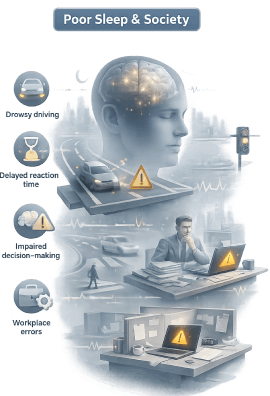
Have you ever thought about how your sleep, or lack thereof, could put you and other people at risk? Studies have revealed that when we do not get enough shut-eye, we pose a danger to others in the following ways:
Road Safety
Getting behind the wheel while tired may not seem like such a big deal. After all, many people do it and get home or to their places of work safely every day, or so it seems.
But did you know that drowsy driving accounts for an estimated 20% of all traffic accidents around the world? Studies go ahead and estimate that on busy roads, like highways, this percentage goes up to 25%. Take the US as an example. Drowsy driving is said to contribute to an average of 1.5 million car crashes every year, with an estimated 8,000 fatalities.
So, how can poor sleep be behind all these accidents? Well, when you have not had enough sleep, your brain forces you to rest in the form of micro-sleeps, such that you seem awake but are actually not quite conscious. With this happening consecutively, it results in reduced activity in the prefrontal cortex, which is the part of the brain that is responsible for making decisions. As such, when you come across things such as hazards, lane changes, or even animals on the road, you fail to notice them in time, and this affects your reaction time. While drivers are sometimes able to walk away from such incidents without causing harm to themselves and others, they are not always as lucky.
Workplace Errors
Whether you work at an accounting firm or a restaurant, research shows that not getting enough sleep can put you at risk of not only making errors in your work but also getting hurt. How?
When you are not getting enough rest, you miss out on important benefits such as emotional regulation, energy replenishment, and more. As such, you wake up tired, which affects your ability to remain vigilant and coordinate your limbs. What’s more, lack of adequate sleep reduces the balance in your dopamine and serotonin levels. All these effects result in slower reaction times, which put you at a higher risk of workplace accidents.
Thus, it comes as no surprise that studies have found that 13% of workplace injuries result from poor sleep. In one Swedish study, for example, the researchers found that workers with severe sleep deficits were twice as likely to suffer a fatal injury in the workplace. And in studies comparing night shift workers to daytime workers, researchers have found that night shift workers with poor sleep patterns were 3 times as likely to injure themselves at work.
These workplace errors do not just impact the workers but also spill over to their clients. Using the hospital as our example, studies have shown that when nurses and doctors do not get enough sleep and work long hours, this affects their cognitive abilities. They are more likely to misdiagnose patients and prescribe wrong medications or doses, all of which can contribute to patient harm. And even outside the hospital, these errors can impact people’s lives greatly. For example, if a restaurant waiter is tired and does not take a customer’s order correctly, they could serve them food to which they are allergic, resulting in a medical emergency.
Sleep, Education, and Development
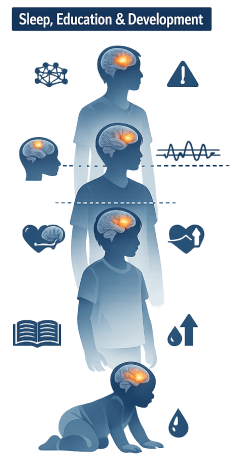
Doctors often say that children need their sleep for development. But just how big a role does it play in their well-being? To understand this, we must look at children in the context of poor sleep through each milestone.
Infants and Children
When children go to sleep, their brains use this time to process all that they have learned while also helping them regulate their emotions and rest their tired bodies. Growth hormone release also takes place at this time to help them literally grow. So, when children do not get enough sleep, they not only miss out on processing new information, but they also are unable to get enough REM sleep, which is critical for emotional regulation. You find that children who are sleep deprived have much lower information retention abilities, have trouble paying attention in class, and face difficulties with managing their negative emotions. Over time, this leads to behavioral issues, developmental delays, and lower academic performance.
Adolescents
Many pubescent children have trouble sleeping because their circadian rhythms shift to later sleeping times, yet their waking times do not change. As a result, many of them suffer from sleep deprivation. Unfortunately, this has an effect on their yet fully developed prefrontal cortexes, which not only reduces their learning capabilities but also their abilities to regulate their emotions and their impulses. You find that as a result, many teens start engaging in risky behaviors, doing worse in school, and exhibiting signs of depression and anxiety.
Young Adults
College is a busy time for most people, what with all the classes and social calendars. It is thus quite common for students to pull all-nighters, which affects their ability to get enough sleep. Many of them also start using stimulants, such as caffeine in coffee and energy drinks, just to stay awake and make up for their increasing sleep debts. But as you would imagine, the lack of sleep takes its toll on them. Their immune systems take a hit, as do their learning abilities and energy levels. Some of them end up dropping out because of burnout, others struggle through the classes, and others suffer health issues.
These effects at the individual level catch up with society. For example, when college students fail to do well in school, the economy suffers as its income-generating potential reduces. Along the same line, when people’s judgment suffers because of poor sleep, they make impulsive decisions that can hurt others, e.g., driving past the speed limit on a highway and causing an accident. It is also important to note that these sleep-related issues tend to compound over the years, such that if they go unchecked, they can result in long-term health issues.
Sleep and Relationships
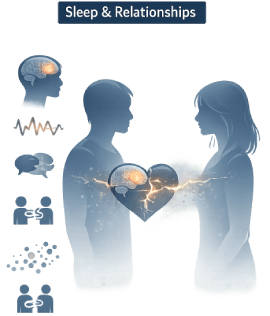
You Relationships not know this, but the amount of sleep you get influences how you feel, which, in turn, affects how you show up in the world. How so?
Poor Sleep, Mood Disorders, and Relationships
Studies have found that people with insomnia are up to 10 times more likely to have depression compared to those who do not. At the same time, their findings indicate that sleep problems are able to predict up to 47% of new cases of major depression in the following year. And that’s not all. The numbers show that 50% of the people receiving psychiatric care have sleep issues. So, is there a link between sleep and mood disorders? Absolutely. You see, sleep plays a vital role in regulating your serotonin, dopamine, and cortisol levels, all of which have an effect on your overall mood. For example, high cortisol levels increase your stress levels and vice versa. So, when you do not get enough sleep, the balance in these and other neurotransmitters takes a hit. If you keep up the poor quality of sleep, you increase your risk for mood disorders such as anxiety and depression. And with more people sleeping less in this modern world, more people have been diagnosed with these disorders, which have hampered their relationships, not only with themselves but also with other people. For example, a person with anxiety may have trouble keeping up with their personal relationships, which others may misunderstand as a lack of interest, thus straining these ties.
Poor Sleep and Interpersonal Relationships
Earlier, we stated that poor quality sleep results in less activity in the prefrontal cortex, and this impairs your judgment. But alongside this effect, poor sleep also results in hyperactivity in your amygdala, such that you have trouble managing your emotions or even showing empathy towards other people. In this state, you are more likely to pick fights with other people, be short with them, and exhibit impatience. Such behavior may not be a big deal in the short-term but it eventually results in rifts between friends, partners, neighbors, etc. In fact, poor sleep can result in divorce.
We should also add that relationships at the societal level are affected. When people are not sleeping well, their impulse control suffers, and their aggression increases. People in such states of mind are more likely to have violent outbursts over small things and engage in risky behaviors, all of which put other people at risk of harm.
The Impact of Poor Sleep on the Economy
Our economies heavily rely on our ability to produce. But do our sleep patterns have any effect on how fast they grow? Why, yes! Here is what you need to know.
Poor Sleep and the Gross Domestic Product (GDP)
National output, which is referred to as the GDP, determines how fast an economy grows, and it includes productivity, income, and expenditure. And sleep plays a very critical role in productivity in the following ways:
The Decline in Efficiency
When people are not getting enough sleep, the glucose metabolism in their brains slows down, such that they end up with less energy available for demanding tasks. They work at a slower rate, make more mistakes, and struggle with solving problems. Eventually, this ends up taking a toll on their production. And since estimates show that 6 in 10 adults are not sleeping well, this reduced productivity is present across various industries.
The Loss of Innovation
Society depends on innovation to solve problems and advance the economy. But with people having shorter sleep cycles, they miss out on enough REM sleep, which is the stage at which they explore their creativity. So, they lose out on creative thinking, which affects their ability to use associative thinking in the workplace. Over time, this reduces their ability to innovate and adapt, which is a huge downside in knowledge-based industries.
The Reduction of Labor
People who do not get enough sleep over a long period of time are at a high risk of chronic fatigue. Such people see a deterioration in their physical and mental health, which reduces their abilities to work and increases their chances of being on disability. So, more people start leaving the workforce and relying on government aid, which inevitably has an effect on the economy as more resources go into covering their needs.
The Increase in Inequality
There is a link between poor sleep and socio-economic status. Studies show that many people doing shift work or living in poor housing conditions are likely to suffer from poor sleep due to their schedules and environments, respectively. These conditions impair their sleep patterns and have an effect on their health and performance, such that they are less likely to do well at work and gain opportunities to advance themselves, which leaves them in a cycle of disadvantage.
To add to this, we have a growing problem of presenteeism. Unlike absenteeism, where workers fail to show up to work, in presenteeism, the workers are physically at work, but they have reduced attention spans and motivation, which has an impact on their productivity. And since they get paid for showing up, companies lose billions of dollars in annual wages to wasted labor hours.
Poor Sleep and Healthcare Costs
Many countries are now starting to grapple with the costs that result from poor sleep, and these are showing up in the following ways:
Direct Costs
These expenses result from the treatment or management of sleep disorders such as insomnia and sleep apnea. Usually, managing such conditions requires interventions such as sleep studies and medication, and these come at a high cost. In the US, for example, estimates show that up to $94.9 billion goes into covering these direct costs. And on average, people with sleep disorders spend an estimated $7,000 more on healthcare each year compared to people who do not have these conditions.
Indirect Costs
Lack of adequate sleep has an effect on people’s health. In fact, poor sleep contributes directly to health issues such as obesity, diabetes, and cardiovascular disease. For example, studies show that poor sleep dulls the fullness hormones and amps up the hunger hormones, resulting in a higher calorie intake, which contributes to a high risk of obesity. These secondary health issues result in an increased need for long-term healthcare, including hospitalization, which increases the existing burden on healthcare systems around the world.
Mental health care costs, as discussed under public health, also add to this strain on healthcare. The economic effect does not just tie to the costs of covering these health costs but also to the reduced economic productivity from the affected individuals. In a much broader context that takes direct and indirect costs into account, a study conducted across five OECD countries (the U.S., Japan, Germany, the UK, and Canada) found that the total sleep-related healthcare costs were $680 billion yearly.