Habits That Improve Your Sleep
People of all ages struggle with sleep, be it the infant who needs rocking to fall asleep or the young entrepreneur who lies awake dreaming of the future. But no matter how old you are, there are things you can do to better your sleep routine. The strategies we share here are aimed at teens and adults, but they can be adapted to work for children. That said, here is what you can do to sleep just like the doctor ordered:
Habit 1: Have a Consistent Schedule
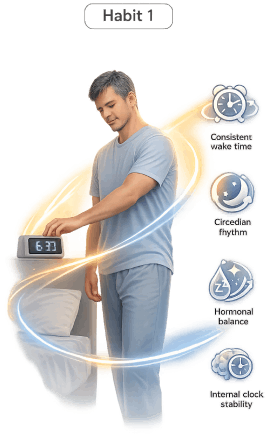
When it comes to sleep, you are subject to the workings of both your circadian rhythm and related rhythms inside your body. Take the circadian rhythm for starters. Through the suprachiasmatic nucleus (SCN) in the hypothalamus, this rhythm determines when you will fall asleep and when you will wake up. In the typical adult, these processes are governed by the light and the darkness such that sunlight triggers the release of cortisol to keep you awake while the setting of the sun triggers melatonin, which helps you relax in preparation for sleep. And in other adults, these processes rely on your lifestyle, such that if you often go to bed at 12 am and wake up at 8 am, then this becomes your circadian rhythm. No matter the force behind these processes, this rhythm helps your body set up an internal clock that also dictates the operations of the organs in your body, like your heart and liver, which affects other rhythms like digestion and hormone production.
So, why does consistency matter? Well, when you stick to this rhythm, you stabilize the inner workings in your body, from brain function to your body temperature. But when you change your waking and sleeping times, then you throw this rhythm off its balance. On a short-term basis, the effects of this show up as daytime fatigue, poor short-term memory, and a reduced ability to regulate your emotions. For example, you may feel exasperated on a day that you have not gone to bed at your usual time or woken up when your alarm often goes off. But from the long-term angle, an inconsistent schedule has a negative effect on your body as it impairs its ability to repair itself and regulate its internal processes. And this leaves you at a higher risk of diseases such as heart disease, diabetes, and obesity.
While it might not be the most exciting thing, having a consistent sleep schedule is important. Where possible, anchor your wake-up times to sunrises, but if not, come up with a schedule that honors your current lifestyle and rest needs. Also, avoid doing catch-ups on weekends as these affect your set schedule. And in cases where you must change your current schedule, try to do so gradually to avoid disrupting your internal processes.
Habit 2: Create a Supportive Environment
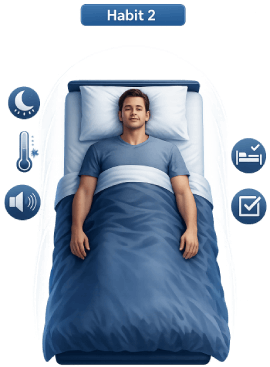
Have you ever noticed how much of an effect your work environment has on your productivity? A simple drop in temperature can affect your focus all day. Well, the same environmental effect applies to your sleep quality and quantity. Studies have shown that poor sleep environments get in the way of deep sleep and REM sleep (where dreams occur), which are vital for processing information and emotions. Once in a while, such disruptions will cause problems such as fatigue, which go away once you enjoy a better night of sleep. But continued over time, these sleep disruptions can lead to long-term behavioral changes, impaired learning abilities, and chronic fatigue.
So, what are these disruptions in your environment, and what can you do about them? When it comes to where you sleep, you want to pay attention to the following things:
Light
Sleeping in the dark triggers the release of melatonin, which helps you relax and sleep. The easiest way to achieve this is by turning off the lights when you sleep, but if secondary light affects you, wearing eye masks or using blackout curtains can help.
Temperature
When your room feels cool (averaging 18–20°C), this prompts your own body’s temperature to dip, which helps you slip into sleep. You can achieve this through breathable bedding and pajamas, as well as setting your AC to cool.
Noise
While some people are okay with noise, for others, such noises can awaken them and bar them from achieving stage 3 sleep, which is where physical restoration takes place. If you are sensitive to such noises, you can use white noise to mask them or invest in a good pair of earplugs.
Tidiness
Research has shown that having clutter in the bedroom keeps your brain from relaxing, which can hamper your sleep. Tidying up before bed can help your brain relax.
All in all, environments affect us differently, and the best way to support your sleep is to understand what works for you. For example, some people like having night lights as this helps them feel safe, such that sleeping in total darkness would hamper their sleep quality.
Habit 3: Be Physically Active

We live in a world where people often equate exercising with the pursuit of fitness or weight loss. As such, many people put it on the back burner. But as it turns out, exercise does more than burn calories and tone muscles. Instead, it also acts as a way to improve your sleep. How?
When you exercise, your body goes through several changes. First, it increases the adenosine levels in your body. You see, adenosine is a sleep-promoting chemical that builds up when we are awake. And with exercise, you get an increased level such that by the time you go to bed, you are so sleepy that falling asleep comes easily. Secondly, exercise calms the body by reducing the sympathetic nervous system activity, which is responsible for fight or flight responses. And finally, exercising helps you use most of the pent-up energy in your body, which helps you regulate your energy better, such that your sleep is much smoother.
Sedentary people, on the other hand, do not get these benefits. Given that they have lower adenosine levels, more unused energy, and higher sympathetic nervous system activity, they tend to have less sleep pressure by the time they go to bed. And it is not uncommon for them to not only have insomnia but also poor quality sleep.
So, how can you get the most out of exercise?
Timing
Exercising later in the day can overstimulate your nervous system and cause poor sleep. It is thus important to do moderate to vigorous exercise early in the day and leave the evening for gentler movements like stretching.
Pacing
While exercise is good for you, it takes a toll on your body, and it is important to either have rest days or alternate between different exercises to ensure that each muscle group has enough time to heal.
It is also important to choose activities that you love because exercise has more to offer than just better sleep.
Habit 4: Mind Your Plate

In the modern world, many people barely meet their nutritional needs. Thanks to our reliance on hyperpalatable foods, which tend to be ultra-processed, many people are deficient in key micronutrients. Unfortunately, these nutritional deficits do not just wreak havoc on people’s health but also their sleep patterns, too.
You see, food as a whole plays a vital role in our neurotransmitters. Take foods high in protein as an example. The body converts the tryptophan in these foods to serotonin and then eventually to melatonin, which helps us relax and sleep better. As such, when people follow balanced diets that meet their recommended daily intake, they are able to get enough melatonin in their systems. Complex carbs are also an essential part of our diet as they provide us with sustained energy levels that reduce wakefulness during sleep. And fats? Well, these play a key role in hormone production, which ensures that our daily rhythms are not interrupted. All these macro and micronutrients work in tandem to boost sleep quantity and quality.
But not all foods are great for sleep. Caffeine, for example, which is found in caffeinated drinks and foods, blocks adenosine receptors, and this delays the sleep pressure that helps people fall asleep fast. Alcohol is another example of foods that hamper good sleep. While many people enjoy its sedative effects, these are only temporary. Into the night, alcohol actually disrupts REM sleep (the dreaming stage), which hampers emotional processing.
But the problem is not just in what people eat but also in how they eat. In most cases, you find that when people have heavy meals before bed, they suffer indigestion, and this disrupts their sleep. In the same way, when people have irregular eating patterns, they increase their risk for metabolic disorders and are prone to poor sleep quality.
The bottom line is that the better your nutrition, the better your energy balance and the stronger your circadian rhythm. Luckily, you do not need to overhaul your entire eating habits. Instead, if you can avoid caffeine later in the day, limit your alcohol intake, drink more fluids, prioritize whole foods, and eat lighter dinners, then you can improve your sleep dramatically.
Habit 5: Have Technology Boundaries
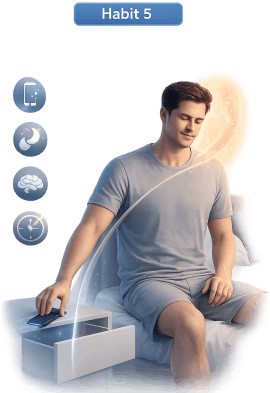
If you are like most people, you enjoy scrolling through your phone before sleeping. Some people do it to catch up with friends, others watch videos online, and others just find themselves doom-scrolling for hours on end. No matter what you are using your phone or other smart devices for before bed, you are likely reducing the quality and quantity of your sleep.
Studies have shown that the blue light emitted by smart devices, like your smartphone, tricks the brain into thinking that it is still daytime. And as such, your body reduces or suppresses its melatonin production at a time when you need it. At the same time, online content, games, and other activities you engage in before sleep stimulate your brain and keep it alert. In this state, your sleep pressure reduces as your brain takes the hint that it is not yet time to power down. That is why it is possible to doom-scroll social media for 3 straight hours on a work night without feeling sleepy, even if it is past your bedtime.
Combine these two factors, and you end up with a growing number of people who cannot seem to stick to their bedtime routines. So, they end up with massive sleep debts that affect their focus and energy levels the following day. Those who end up caught in this cycle also end up at a high risk of burnout, anxiety, depression, and behavioral changes over the years.
Can you avoid this? Of course. Some of the best strategies include:
Boundaries
Research shows that if you can avoid using your phone and other smart devices for 1 to 2 hours before bed, you can limit your melatonin suppression. In cases where such a limitation is not possible, you can use blue-light filters or wear blue-light-blocking glasses.
Replacement
Most people turn to their phones for entertainment, and once they start scrolling, it becomes hard to stop. But there are many other ways to pass the time or entertain yourself that do not leave you in this sleep debt trap. These include journaling, meditation, reading physical books, etc. Through experimenting, you can find alternatives that allow you to gently wind down before sleep.
As much as it takes time to wean yourself off late-night doom-scrolling habits, the trade-off is worth it.
Habit 6: Manage Your Stress

Did you know that as many as 1 in every 3 adults suffer from insomnia? That’s right. There are billions of people in the world who have a hard time falling and staying asleep. And while the causes of insomnia are often varied, many of them come down to elevated levels of cortisol, which hamper the release of melatonin.
But what raises cortisol levels? The thing is that cortisol is our stress hormone, and its elevation is often in relation to how stressed we are. Take the example of when people are going through periodic stressors, such as exams, looming deadlines, and other such events. What happens? They become stressed, start ruminating over what will happen, and this raises their cortisol levels. Now, this becomes a cycle. Why? With the raised cortisol, the melatonin levels drop, and these stressed-out people end up sleeping poorly because their sleep cycles become disrupted. As a result, they not only wake up tired but also have trouble processing their emotions. As you would imagine, this raises their stress levels again, setting the ball rolling for more nights with fragmented sleep. Over time, this can pave the way for more serious problems such as anxiety, burnout, and depression.
As we all know, you can’t just snap out of it when it comes to feeling stressed. But you can manage your levels to help you sleep better. How?
Mindfulness
While ruminating over what can go wrong might be at the forefront of your mind, it is important to find ways to calm your mind. You can do this through breathing exercises and progressive muscle relaxation, as these help bring your mind back to the present.
Rituals
We all have things that soothe us when things get hard. They can be as simple as a long shower or a warm cup of tea. Or they can be as indulgent as a day in the spa or a hike up a hill. Do what you can to ease your mind and feel like yourself again. The idea is not to escape your reality but to take care of yourself in spite of it.
Journaling
Racing thoughts can take over if you do not address them. And one of the best ways to do so is by writing them down. Be real and raw, and do not worry about coming off correctly. These are just your thoughts, and by penning them down, you transfer that worrying energy to that paper and allow your mind to rest.
Talking to someone is also very effective. It can be someone you trust, like a partner or a friend. Or it can be a therapist. Choose the person with whom you feel most comfortable to be vulnerable. As they say, a problem shared is a problem solved.