Sleep Needs Through the Years
We all rely on sleep for physical, emotional, and mental restoration. Every time we go through a complete sleep cycle, we get refreshed, and the more sleep cycles we get, the more reinvigorated we feel. While studies have shown that there is such a thing as too much sleep, the main problem we face in our society tends to be the converse, such that people are not getting enough sleep. So, what counts as enough? Well, it all depends on your age, as follows:
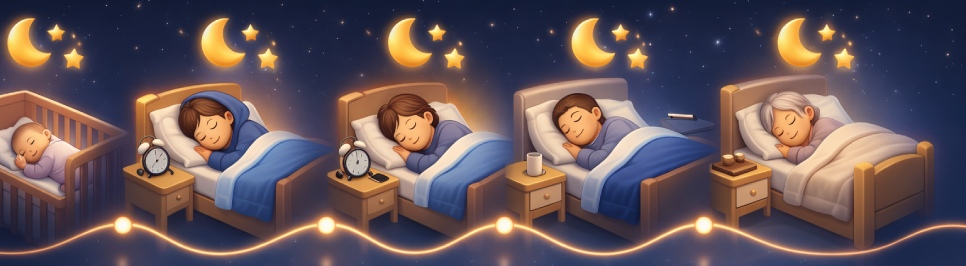
Infancy (Children Aged 0 to 2 years)
It is a well-known fact that babies need their sleep. Not only does it aid with their brain development, but this time spent resting helps them regulate their emotions, form memories, process the new senses, and grow. That last aspect is quite literal because when babies are asleep, their bodies release the growth hormone, which is essential in helping them grow physically. Besides, babies need some shut-eye to take a break from all the new experiences they encounter daily, from new places to new faces.
Studies show that for newborns, the goal should be 14 to 17 hours of sleep a day, which should be divided across the day in short cycles. By the time babies are a year old, they can transition into longer sleep cycles, averaging 12 to 14 hours with 1 to 2 naps a day.
But as any parent will tell you, getting a child to sleep this long is quite the challenge. Babies often have irregular sleep cycles, which can be brought on by their need for frequent feeding, health issues such as colic, and even environmental disruptions such as noise. Sleep disorders such as night waking and behavioral insomnia can exacerbate these issues, resulting in poor sleep.
Unfortunately, when babies do not get as much downtime as they need, it affects them such that they have trouble self-soothing and may seem irritable. It also impairs their learning ability. But it’s not just the babies who get affected. Their caregivers, too, are unable to get enough sleep, which stresses them, affects their ability to bond with the baby, and leaves them at a higher risk of fatigue-related accidents.
Early Childhood (Children Aged 3 to 5 years)
Between the ages of 3 and 5, many children get thrust into the engaging world of formal learning and socialization. And sleep helps them put all these new experiences to use. First, it helps them learn language by consolidating what they have learned throughout the day. Secondly, it helps them regulate their emotions through REM (rapid eye movement) sleep, where they also get to consolidate their new motor skills. Third, it supports their immune system by helping the body repair itself, which is vital for children as they are often susceptible to communicable diseases. All these factors help children navigate the social, mental, and emotional challenges that they come across in school and other venues where they interact with other people.
But how much sleep do they need to hit all these goals? Research states that children in this age group need 10 to 13 hours of sleep a day, with 1 nap included.
While children at this age do not have frequent changing or feeding times, getting them to sleep is still a challenge. Much of this comes from their pushback as they try to assert their independence as they grow older. In other cases, the issue may stem from sleep disorders such as night terrors and sleepwalking, which are common at this age. And at others, the challenges arise due to inconsistent bedtime routines or excessive stimulation before they sleep. More recently, studies have shown that increased screen time at night results in lower quality sleep in children.
It is very important for parents to address such challenges because poor sleep greatly affects children. The effects show up as difficulty in regulating emotions, a higher risk of infections, and trouble with following classes. And since poor sleep influences hormonal changes relating to hunger and fullness cues, children who do not sleep enough are at a higher risk of obesity.
Middle Childhood (Children Aged 6 to 12 years)
As children go through elementary school, they juggle different aspects of life. On one hand, they start learning how to manage complex social relationships between them and their friends and families. On the other hand, they have school responsibilities which include classes, projects, sports, and assignments. And all this happens while they are still growing physically. As you can imagine, sleep becomes a very vital part of their lives. It helps them process new information learned at school, store the memories they are making, and regulate their emotions. Plus, it supports their growing bodies while offering them a line of defense against illnesses.
So, how many hours can support all these moving parts? Studies show that most children in this age group do well with anything from 9 to 12 hours per night. By this stage, naps are no longer necessary, and children can make it all day without the additional shuteye.
Is it easy for parents to get children in this age group to sleep on time and enough? For the most part, these children stick to their sleep schedules. However, where the children have too many school responsibilities, their projects may eat into their sleep hours. Also, where these children have anxiety over their relationships with family and friends, this can affect their ability to sleep, as can excess screen time at night. Like with younger children, lack of adequate sleep causes poor mental focus, behavioral issues like irritability, a weak immune system, and a higher risk of obesity.
Adolescence (Children Aged 13 to 18)

Puberty and adolescence come with a myriad of physical, emotional, and psychological changes, and children are often very confused about their bodies at this time. As one might expect, sleep becomes the foundation on which teenagers can rely during this stage. In fact, studies have shown that getting enough sleep is one of the best ways to regulate the influx of hormones, especially the growth and reproductive hormones. And to do this, experts advocate for adolescents to get between 8 and 10 hours a night. But do they?
Well, not quite easily. You see, the changes in adolescence cause a shift in the circadian rhythm that makes more teens feel more awake at night. So, a child who was previously hopping into bed by 9 pm now wants to stay awake till 1 am. This change would be okay were it not for the fact that adolescence also coincides with early school start times. And when a teen gets into the habit of staying up late and waking up early for school, it sets them up for sleep deprivation. Another big barrier to sleep at this time is the reliance on technology that we see in this modern age. With more adolescents using their phones and computers till later at night, their melatonin production reduces, which makes it harder for them to relax and sleep. Add the stress of school and social dynamics, and sleep becomes elusive for some adolescents. Sleep disorders such as insomnia, narcolepsy, and delayed sleep phase disorder can also occur during this period.
Poor quality sleep during adolescence is not without its risks. As we all know, sleep helps people regulate their mental and emotional states. So, if you take that out of the equation, adolescents are more likely to give in to their impulses and engage in risky behaviors. They are also likely to have reduced performance in school and exhibit behavioral issues such as mood swings.
Young Adulthood (Adults Aged 19 to 40)
The life of young adults is often go, go, go. They have school, work, friendships, and romantic relationships to juggle. And at some point, it feels like 24 hours are just not enough to cover all these bases. But as science would have it, sleep is still important even in light of all these new experiences. It gives these young adults the restoration they need to have peak cognitive performance, manage their emotions well, and take care of their physical health. And scientists agree that 7 to 9 hours of sleep a night will serve many young adults well.
That said, are they eager to hit that reset button? While many young adults stick to a good sleep routine, there are barriers along the way. To start with, the competing work, study, and social needs often result in people sleeping less so they can have more time for other things. Secondly, a good chunk of these adults have shift work or other irregular work schedules, which affect their circadian rhythms and make it hard for them to have a set pattern. And in many cases, these adults make lifestyle choices that impact their sleep negatively. These include drinking alcohol, having one too many cups of coffee, and doom-scrolling.
When these young adults have poor sleep, their decision-making abilities get impaired, as do their productivity levels. Their emotional states also suffer, and they are likely to exhibit erratic behavior that can strain their relationships. Unfortunately, if they continue down this trend, it puts them at risk of lifestyle diseases such as obesity, diabetes, and hypertension. And these issues can carry on throughout the rest of their lives.
Middle Adulthood (Adults Aged 41 to 64 Years)

By the time people get to their forties to sixties, their responsibilities have increased. They have their careers or businesses to think about, and on the other side, they have their families to consider. Add friendships, neighborhood associations, school meetings, and tons of other moving parts in here, and most adults just need a break. And this comes in the form of sleep, which helps them maintain their cognitive performance, take good care of their hearts, manage their metabolism, and serve as a buffer against stress. And according to science, adults in this age group can stick to the 7 to 9 hours that younger adults need. However, it is important to note that the sleep efficiency reduces at this stage of life, albeit slightly.
Does sleep come easily to these adults? The truth is that many of them face challenges in getting that shuteye. One of the biggest setbacks is stress. With career and family roles to play, many adults have a lot on their plates, and the anxiety from this can hamper a good night’s sleep. Another key issue is health conditions. Sleep disorders are common during this stage of life, and they range from obstructive sleep apnea to insomnia and restless leg syndrome, all of which affect sleep. To add to this, many adults start grappling with health issues such as chronic pain, which makes it harder to fall asleep. And for women, premenopausal changes can take a toll on their bodies due to effects such as night sweats, which, again, are not conducive to a good night’s sleep.
For adults in this age group, poor sleep does not just bring about fatigue, irritability, and lower productivity. It also increases their risks of lifestyle diseases such as cardiovascular disease, and results in the decline of their memory.
Older Adulthood (Adults Aged 65+ Years)

As people get older, they get to take a step back and relax. For this reason, you find that many people in their late sixties and above have more time on their hands. They garden, go on trips, paint, and spend more time with their loved ones. So, does taking it easy mean they can go without as much sleep as before? Not really. Studies have shown that even when people are chasing sunsets and dancing the evenings away, they still need to get enough sleep. This rest supports their immunity, boosts their cognitive function, and helps them retain their memories. And if these older adults want to make the most out of this downtime, they should aim for 7 to 8 hours a night.
But sleeping is easier said than done for many adults at this stage. For one, as you grow older, your sleep becomes lighter and much more fragmented. As such, you find that many of them start sleeping less than they would have in the past. Secondly, deep and REM sleep stages reduce, such that most adults spend their sleep in stage 1 and stage 2 cycles, which are the lighter kinds of sleep. Thirdly, circadian rhythms tend to change at this point, and adults find themselves sleeping earlier and waking up earlier. And fourth, health conditions rear their heads. These can be sleep disorders such as insomnia, sleep apnea, and periodic limb movement disorder. Or they can be general health conditions, like chronic pain, which can also affect sleep.
Unfortunately, health risks increase with age. And with sleep serving as a health aid, poor sleep comes with many risks. These include a higher risk of cognitive decline, illnesses, falls, and irritability. Poor sleep is so detrimental that it has been linked to an increased risk for dementia.
Adapting at Every Stage
Given the sleep trajectory we have covered in this sleep guide, we can see that sleep needs decrease with age. However, it is also apparent that they also coincide with one’s stage of life, such that when you are more active, you need more sleep and vice versa. But regardless of your age and stage, it is clear that sleep is a vital part of our lives.
When poor sleep quality becomes the order of the day, negative consequences follow, ranging from developmental delays in childhood to an increased risk of injuries in older adulthood. What’s more, the negative effects experienced in one life stage can dramatically affect a person in their next life stage. For instance, lifestyle conditions developed during early adulthood can last till older adulthood, further complicating a person’s sleep and, therefore, quality of life.
As such, it is important for people to be aware of the challenges that they face at each stage in life and to come up with stage-specific strategies to improve their sleep so as to keep these likely issues at bay while also improving their health.